


Women and Guleet by Tadesse Mesfin
Author: Senait Feseha - June 16, 2018
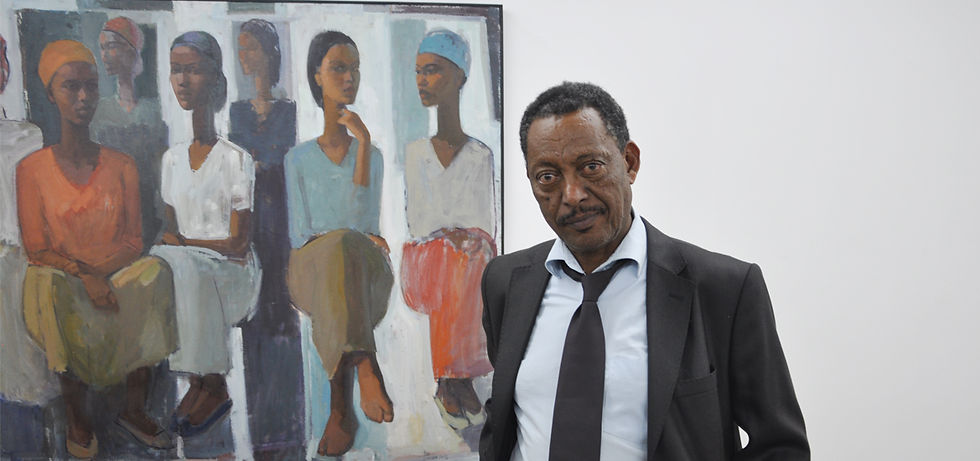
“I am obsessed with these women,” said Tadesse Mesfin as he pointed towards the brown skinned women with long necks and slender bodies.
Tadesse is widely recognized as one of the most important and influential artists in the Ethiopian art scene. In his most recent solo exhibition entitled “Pillars of Life: The Power and Grace of Market Life”, Tadesse presented nine pieces that remain faithful to his fixation, feminine figures.
The figures, many of whom wear head wraps, simple blouses, ankle length skirts, and bare feet are a reminiscent of Taddese’s travels to the southern parts of Ethiopia as well as Harar.
His work celebrates the women who work as vendors in several ‘guleet’ markets around Ethiopian cities. Even though most artists choose to convey markets as bustling sites with vibrant colours, eclectic mixture of goods, and a dynamic crowd, Tadesse captured the stillness. He revealed the absolute quiet by putting his focus on these women.
In one of Tadesse’s favourite pieces titled “Saturday Market”, one can easily observe that the painting is populated by women. This comes natural to anyone familiar to the local market experience as women tend to dominate the market place due to traditional and gender roles the society has established for centuries. But instead of displaying the energy of the market, as one would expect, the artwork focuses on only four of the women. They look calm, standing in a statue-like manner.
With his minimalistic approach, he guides the viewers’ vision through strategic compositions. The paintings only communicate what he considers significant; helping the audience appreciate “guleet” markets through his eyes. This is done by painting the women on the foreground using sharp, hard edges and borders while everything else in the background is painted with soft or sometimes invisible edges that disappear with distance.
As a man who is obsessed with the compositions and postures of these women, he explains how it all started. “I spent three months travelling Yabelo, Tuba, and Harar regions, amongst other parts of Ethiopia. I observed different colours, the shades and shadows created by the lighting…I thought to myself ‘this people look wonderful’ that is how they became my inspirations.” After a while, he started wondering what he would do if these women were not nearly available. That is when he decided he can use the women selling goods at the markets (guleet) as his subjects.
“I view these women as sculptures. My concern only lies on the structures, the way they sit, their posture, and so on. I compose them however I want, just like sculptures. They are my endless resource; i already have the subjects, I don’t need to change that.” He believes this is a result of spending a lot of time working on them.
Most of the paintings are characterized by drawing attention to facial expressions and toning down the excessive use of colour, but in some cases, like the pieces titled “Guleet” and “Neighbours” he tries to capture the vibrancy of markets by using a range of saturated hues in the women’s clothing.
These distinct characteristics have opened doors to some criticisms at the exhibition. Some viewers commented that even though they appreciated the cohesiveness of the overall display, most of the pieces were similar to each other. “I liked the paintings,” said Nebyou Gethahun, an attendee at the exhibition, “but I feel that the paintings would be more appreciated if they were displayed individually. Together, they look alike, too similar. At some point I started wondering if the painter repeatedly drew the same woman on multiple canvases,” he said.
Konjit Seyoum, an educator, an artist, and curator of Asni Gallery, disagrees “I don’t believe they are the same. In order to understand the artist and his paintings, one has to take a little more time and pay attention,” she continued, “I think he is the only artist we have today who has spent a lot of time perfecting what he does…and because he has spent a lot of time perfecting his work, it seems that he has found the main substance.”
“The way he uses colours have evolved, and now it’s hard to decipher but, his paintings are turning into statues,” Konjit said.
Similarly, within the art community, Tadesse’s accomplishments are believed to rest on his highly individualized use of colour, and flatness of his paintings.
Tadesse says his work is characterized by being flat (two dimensional), with no depth (perception) “just like Ethiopian and Egyptian art, the backgrounds I use in my paintings are flat, with no depth and my subjects are frontal.” He also believes that his greatest achievement is being able to make the paintings flat. “I don’t need depth; I just want to be able to play with the space.”
Tadesse Mesfin was born in Weldia, Ethiopia on 1953; he attended the Addis Ababa University School of Fine Arts and Design. He was taught by the “Father of Modern Ethiopian Art”, Gebre Kristos Desta; he graduated with distinction. Tadesse then travelled to Russia, to study at the Repin Academy of Painting, Architecture and Sculpture. He then graduated with Honours in a Master of Fine Arts Degree in Painting. Tadesse has spent the last thirty three years teaching at the Alle School of Fine Arts. He has won the 1998 prestigious Mid-American Arts Alliance.
His latest exhibition, Pillars of Life: The Power and Grace of Market Life is curated by the Addis Fine Art, a gallery that specialises on contemporary African Art. It is open from June12 – July 21 2018 Tuesday- Saturday. And according to an employee at the Addis Fine Art, nearly all of Tadesse’s paintings sold out before the exhibition officially opened to the public.
Originally published:https://www.thereporterethiopia.com/5709/
Comments